
This Book is NOT Called "Atomic Noodle"

Automatic Noodle by Annalee Newitz
Pages: 164 Genre: science fiction
Rating: 2 Star

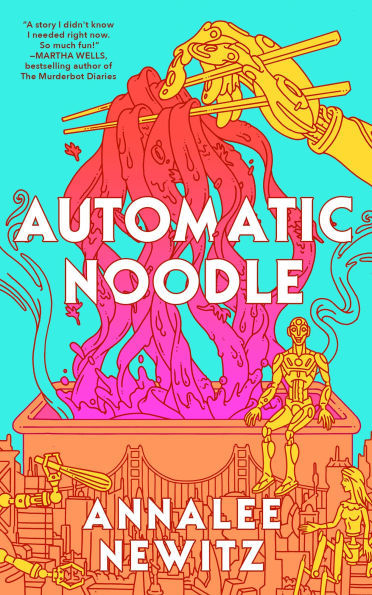
San Francisco is rebuilding as part of the new nation of California after a devastating war with America. A group of robots who work in an abandoned ghost kitchen decide to rebuild their storefront out of their own dreams. They open a noodle shop that is quickly beloved, until they start getting review bombed on the main delivery app.
I read this book in basically one sitting, and while I didn't hate it, I didn't love it either. I have a lot of issues that I can pinpoint specifically, but I also think I just wasn't vibing with it.
My biggest complaint with this book was the way it talked about California. From the apparent Civil War that separated America and California to the way that people (robots excluded) talk about America as if it's a boogieman of a country, it makes the author's apparent adoration for their state come across less like genuine love and more like smug superiority. We get it! You live in a blue state! Following what is presumably a Civil War, your baby nation will be a utopia where your biggest problem is "robophobia" while America is off being evil and racist. It gave me the same feeling as when liberal people in blue states liberally proclaim their glee over red states experiencing natural disasters that devastate impoverished and minority communities because, "well, you voted for this!" This is the vibe I just wasn't meshing with.
The main aspect of this very short book is the discrimination that the robots face. After a Civil War they are granted half rights — for example, they can work, but they cannot vote. Sound familiar? Using robots and future imagined robophobia (a term that this book uses frequently) is not unique to "Automatic Noodle." Since we've been imagining robots, we've been imagining them being discriminated against in dystopian science fiction. I know this is a clunky allegory even at its best, but I think some stories with this premise are at least somewhat compelling. I thought this book missed the mark for a few key reasons:
1) The worldbuilding in regards to the robots specifically was lacking. Yes, there was general societal-wide trauma/impacts of war, but if you're curious how or when or why the robots were able to develop a human-like sentience, you're going to be disappointed. In some ways that's fine, because this isn't a book about the rise of robot consciousness. But some thought in that department — at least with these four robots specifically — would've helped the robots feel more like actual characters rather than, well, artificially-created identities used to make the author's desired point. The book won't like me saying it, but it did feel inauthentic.
2) The tone felt too goofy. The duality of describing real horrors and violence of war and also the chill, relatively low-stakes plot about getting bad reviews on your restaurant made the whole book feel super disorienting. If the restaurant doesn't succeed, these characters are going to be sold into slavery, by the way, so calling it "low-stakes" isn't even accurate. It's a wildly high-stakes plot being covered clumsily in a fluffy blanket where the main problem is online trolls and racist Discord servers.
At a certain point, it started to remind me of the "clanker" memes from late 2025. For those unaware, I'd recommend just looking them up, but the short version is that, on the back of people being annoyed with the rise of AI, users were imagining a future where we live with sentient robots but treat them with the same kind of racism that America has historically treated Black people and other racial minorities with. The word "clanker" was taken from Star Wars as a robot slur, and then many others were created that were just real slurs but with a fun techy twist, and it ended up with most people just using it as a way to Play Pretend Racist. This book was released before the trend actually took off, but if you told me that it was inspired by it, I'd believe you. Which is not a good feeling to have while reading a novel.
3) I'm simply not sympathetic to AI right now. I get that this is a fictionalized novel and it's different and that I'm choosing to be a worse reader by not genuinely engaging with this book. But it's imagining a future to our world, and I live in this world, and I'm not willing to sympathize with AI "sentience." Concepts like this don't exist in a vacuum. I can't ignore that they're suddenly the best place to get this kind of noodles in the city — unseating the people who do have a cultural tie to the dish, by the way — because they can make it "perfectly" with robot precision. This is a point made in the book, and it's similar to how people talk about AI now. Again, I get that it's different because these robots are genuinely sentient, but where do we draw that line? Is being programmed to mimic human behavior that different from wanting to do it because you ... want to? Sorry, but I am going to question where people fit into this equation.
You're not going to believe me, but I did like the story beats of this book. It certainly made me want to try biang biang noodles. But I was overall unimpressed with the writing and the implementations of the central allegory.


Comments