
No, It's Not That Movie

The Passengers by John Marrs
Pages: 400 Genre: thriller
Rating: 2 Star

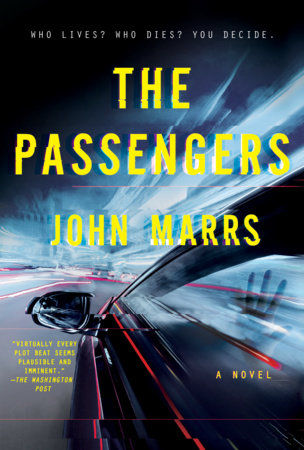
Fully self-driving cars have taken over the UK's roads, to varying degrees of acceptance. The highest level of car lacks even a manual override option, leaving the passenger at the will of the vehicle. Today, though, eight cars have been taken over, and the Passengers are being sent to a collision point. A jury, and social media, must decide who gets to survive.
In many ways, I was really surprised by how much I disliked this book. I loved "The One" (I gave it 4 stars) when I listened to it two years ago, but I'm starting to think that consuming it as an audiobook really saved the story, because I was primarily put off by the writing. Many of the sentences were overly wordy and desperately needed editing (to a distracting degree), the "blocking" of many scenes was entirely incomprehensible, and the dialogue was so unnatural that it took me right out the story.
I will admit that I was immediately put off because the promised premise felt too different from the fairly standard thriller that was delivered. I didn't realize this was the sequel to The One, and I thought it would be more centered around the Passengers themselves trying to work out what was going on and how to survive. Instead, we spent most of our time outside of the cars in the minds on an onlooker, Libby. I don't think this choice would've bothered me so much if it didn't feel like the rug being pulled out from under me.
I cannot express to you how distractingly bad the writing was. So many sentences felt clunky with the amount of extra and unneeded words there were. Also, it seemed like we couldn't be expected to understand much, since every single thought and character motivation had to be explained to me outright.
None of these characters talked like real people either. I feel like I can't explain this, so I'm just going to include some of my favorite examples (spoiler free):
"But then he ruined it all. And as well as losing him, now I'm going to lose you too."
"Your doctor called to check on your recovery and was unaware of my ignorance and your deception."
"So why shouldn't I too be allowed to play a game of my own?"
Again, it's just clunky. Most of the main characters we spent time with were caricatures of people meant to represent an ideology, not characters meant to have their own personality. The Passengers were there to be scared for and deceived by, so their stories were over-the-top dramatic. A lot of the "thriller" aspects came from the extreme graphic nature of the events of the book rather than the dilemma itself, which should've been allowed to speak for itself.
The villains were also not great, which I debated including in my review. I try to avoid spoilers, and I'm going to keep doing that. But it was clear who the "nuanced" characters were meant to be compared to the "bad" characters, because all of the latter talked and acted like cartoon supervillains that were yes-and-ing the protagonists. The Hacker had to be unstoppable for the plot to work, which meant he had a ridiculous amount of contingency plans. At a certain point it felt like I was just reading the responses to an editor going "well why don't they just do xyz?"
There was also a chapter at the end that felt like I was just reading all of John's research. To the point where a character described an online survey focused on the very issue of self-driving cars and the AI behind them when another character outright said, "Oh yeah, the Moral Machine!" It was a shocking lack of subtly or clever integration that took me right out of the story and, it felt like, right into a Twitter thread.
On that note, the way social media was included in this book felt the same way it always feel when an author tries to deliver a take on social media that may be, heh, a little controversial — sometimes people are bad on there! It was predictable. Boring. The random social media guy that gets brought in half way through to vocalize the general online opinion was (as with everyone else) not a real person. It's just not compelling to me to learn that another person who wasn't raised on the Internet sees every social media user as an evil and heartless. Yes, mob mentality, sensationalizing tragedy, and general apathy are problems. It's not exactly groundbreaking.
I had a hard time figuring out if the author did a good job of writing a layered story with criticism of a lot of aspects of society or if he was actually falling into pitfalls. The meta misogyny and racism (and, like, one line that felt randomly homophobic, but that's not a big deal in comparison) could've been done on purpose as a reflection of the characters or on accident as a reflection of John Marrs. I feel very differently about the book depending on if it's the former or the latter. It didn't feel good, I'll say that much, but I want to be fair.
If the general writing quality had been better, I wouldn't have minded a lot of the other issues as much. But because I was so far removed from the story, I was more critical of the whole than I would be otherwise. I genuinely don't know if there's a massive quality difference between this book and "The One" or if listening to it covered it up, but I was really disappointed. I think I have to let this be the last Marrs book for me.


Comments